my role

As sole designer, led UX strategy and interaction design for key CRM workflows, collaborating with product, engineering, and research partners to improve clarity and user task flow.

impact

Concept work helped articulate clearer CRM workflows that supported sales and lead management efficiency, influencing internal discussions on experience priorities and interaction patterns.

challenge

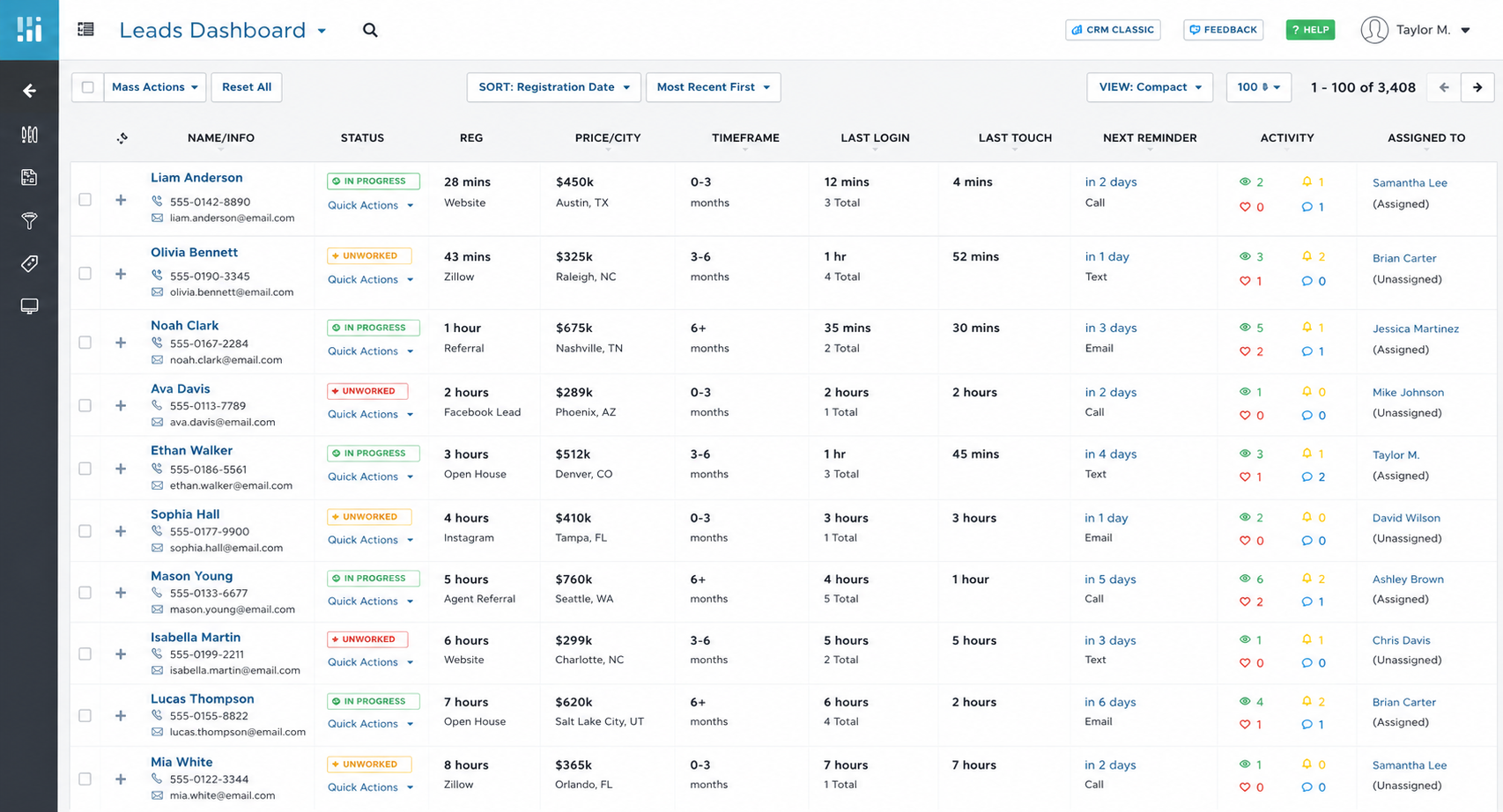
CINC’s CRM needed to support a wide range of sales and lead management activities while minimizing cognitive load for agents under time pressure. The existing complexity made it difficult for users to quickly understand task status, prioritize leads, and navigate between key actions. The goal was to design concepts that better aligned CRM workflows with user needs and real estate sales expectations without introducing unnecessary complexity.

approach

I started by identifying core CRM activities (lead follow-up, status updates, prioritization, contact history) and mapped how users performed these tasks in real scenarios. Through stakeholder interviews, usage observations, and real estate field patterns, I developed interface concepts that prioritized scanability, clear status cues, and efficient task transitions. Prototypes were iterated with product partners to ensure alignment with technical constraints and usability goals.

key insights

  • Clear lead status indicators significantly reduce uncertainty in prioritization.
  • Persistent action cues (e.g., follow-ups) help users stay focused on high-value tasks.
  • Consolidating history/context in visible panels supports faster decision making.
  • Users prefer predictable patterns (status → next action → results) in CRM flows.
  • Early alignment on workflows accelerates development planning.

outcome

The concepts provided a structured foundation for CRM workflow refinement and helped product teams align on priority areas for improvement. While work continued iteratively, this exploration clarified how interface patterns could support faster lead management and reduce cognitive overhead for CINC users.

reflection

Developing CRM concepts reinforced that enterprise tools must balance feature richness with scanning ease and prioritization clarity. By anchoring design decisions in real workflows and field-aligned patterns, the team improved its ability to make product decisions grounded in real user needs. Given more time, usability validation with users in active selling scenarios would further refine interaction nuances and surface edge cases.

CRM dashboard showing clear lead status and priority indicators.

Sample of major refactor of CRM+ navigation, showing tiered options based on selection. As the company grew, the navigational hierarchy became enormous. This concept explored nesting to create better wayfinding across the app.

Version 2 of both the Agent and Consumer products for Desktop, Tablet and Mobile. Agents and brokers could make real-time updates to their listings, easily access buyer info and site activity, and communicate directly with interested buyers all in a single platform.

Some early UI Wireframe sketches that would become the basis for the revised home search experience

Related Projects